MFG Day: Opening the Door to Manufacturing Careers
Manufacturing Day is about showing the next generation what manufacturing really looks like.
Across the country, manufacturers, schools, colleges, workforce organizations, economic development groups, and community partners are opening doors, hosting events, and creating hands-on experiences that introduce students and families to modern manufacturing.
That matters because many young people still have a limited picture of what manufacturing is and the careers it offers.
Manufacturing today includes machining, welding, engineering, quality, maintenance, automation, robotics, cybersecurity, supply chain, accounting, sales, programming, and much more.
There are a lot of ways to build a career in manufacturing.
It Takes a Region
One organization cannot build the future manufacturing workforce alone.
It takes manufacturers willing to share their workplaces and their stories. It takes schools and colleges connecting students to opportunities. It takes workforce and economic development partners helping people understand where the jobs are and what skills are needed.
Most importantly, it takes opportunities for young people to see manufacturing for themselves.
A plant tour, hands-on activity, conversation with an employee, or chance to make something can change how a student thinks about manufacturing.
More Than a One-Day Event
MFG Day may be one day on the calendar, but the bigger goal is to build awareness throughout the year.
Manufacturers across the country continue to face workforce challenges as experienced employees retire, technology changes, and new skills are needed on the shop floor.
Building that workforce starts long before someone applies for a job.
It starts with awareness.
If students do not know what modern manufacturing looks like, what the jobs are, or what those careers can offer, manufacturing may never make it onto their list of possibilities.
Showing What Manufacturing Really Is
Manufacturing is about making stuff, but it is also about problem solving, technology, teamwork, creativity, quality, and continuous improvement.
MFG Day gives all of us involved in manufacturing an opportunity to tell that story.
Across our region and across the country, manufacturers and community partners are helping young people see that there is a place for them in this industry.
And that may be one of the most important things we can do to build the manufacturing workforce of the future.
Labor Day: Celebrating the People Who Make Stuff
Labor Day is a good reminder that manufacturing is ultimately about people.
We talk a lot about automation, technology, productivity, quality, supply chains, and growth. All of those things matter. But none of them happen without the people who show up every day and make stuff.
They run the machines. Solve problems. Inspect parts. Keep equipment running. Schedule jobs. Train new employees. Ship orders. Work with customers. Improve processes. And when something goes wrong, they are usually the ones figuring out how to make it right.
Manufacturing work has changed dramatically over the years. Today’s plants rely on advanced equipment, software, data, automation, robotics, and increasingly AI. But technology does not eliminate the importance of people. In many ways, it makes skilled employees even more valuable.
The strongest manufacturers recognize that.
They invest in training. They listen to the people closest to the work. They capture knowledge before it walks out the door. They develop supervisors and future leaders. And they look for ways to make jobs safer, easier, and more productive.
Labor Day is also a chance to recognize something that can get lost when everyone is focused on schedules, shipments, and the next problem that needs to be solved.
The work matters.
The products made in our region end up in aircraft, trains, defense systems, medical products, energy systems, infrastructure, consumer goods, and countless other places.
Behind every one of those products are people who know how to make things.
So this Labor Day, we want to recognize the people working across manufacturing in the Southern Tier and throughout New York.
Thank you for the skill, knowledge, problem solving, and hard work you bring to manufacturing every day.
And enjoy the long weekend. You earned it!
Is Your Company Growing or Just Getting Busier?
Everyone is busy.
Orders are coming in. The backlog is growing. People are working overtime. Supervisors are juggling priorities. Production is pushing to get one more job out the door.
From the outside, that can look like growth.
But is all that activity actually creating value?
There is a point where being busy and growing are not the same thing. Sometimes the business has simply outgrown the processes, systems, and routines that used to work just fine.
What Worked Before May Not Work Now
A process that worked well when you had 20 employees may start to break down at 40.
The scheduling system that worked when you had a handful of major customers may become much harder to manage when the customer base doubles.
The experienced employee who could keep everything straight in their head may suddenly become the bottleneck when more people, products, and orders are added.
Nothing is necessarily “wrong.” The business may simply have changed while the way the work gets done has stayed the same.
That is when growth starts creating more stuff instead of more value.
What Does “Busy” Look Like?
It can show up in ways that feel normal because everyone is working hard.
Maybe you are seeing:
- More overtime just to keep up
- More work-in-process inventory
- More expediting and schedule changes
- Longer lead times
- More rework
- More time spent looking for materials, tools, or information
- More meetings to figure out what is happening
- More pressure on a few key employees
- More customer calls asking where their orders are
None of these things automatically mean the company is struggling. In fact, they can show up when business is strong.
The question is whether they are temporary growing pains or signs that your processes have not kept pace with the business.
More Activity Does Not Always Mean More Value
It is easy to equate activity with productivity.
If everyone is moving fast, answering emails, moving material, changing schedules, working late, and solving problems, it certainly feels productive.
But how much of that effort is actually helping create what the customer is willing to pay for?
Expediting an order because the schedule changed three times is activity.
Reworking a part is activity.
Moving inventory from one side of the plant to the other is activity.
Searching for the latest drawing is activity.
Fixing the same recurring problem every week is activity.
People can be incredibly busy doing things that should not need to happen in the first place.
That is why adding more people, more overtime, or more equipment is not always the first answer.
Sometimes the better question is why the existing process requires so much effort.
Look at the Process Before Adding More
When demand increases, the natural response is often to add capacity.
Hire another person. Add another shift. Buy another machine. Carry more inventory.
Sometimes those are exactly the right decisions.
But first, it is worth understanding where the work is getting stuck.
Where are jobs waiting?
Where does information get lost?
Where are employees constantly working around the process?
Which problems keep coming back?
What tasks depend on one person knowing what to do?
Where are people spending time on work that does not actually add value?
Those questions can reveal whether you truly need more capacity or whether the existing capacity is being consumed by inefficient processes.
Growth Should Make the Business Stronger
Healthy growth does not mean everything suddenly becomes easy.
Growth creates challenges.
But over time, increased sales should lead to a stronger business, not just a more exhausted one.
That means building processes that can handle more volume without requiring everyone to work harder every time another order comes in.
It means making it easier for employees to do the job correctly.
It means reducing unnecessary movement, waiting, rework, and firefighting.
It means creating systems that support the business you have today, not the business you had five years ago.
If everyone is busy, that may be a sign that business is good.
But if everyone is constantly scrambling, it may be worth looking deeper.
Maybe the question is not, “How do we keep up?” but “What needs to change?”
Cybersecurity Is Now a Sales Requirement, not Just an IT Issue
For years, many manufacturers treated cybersecurity as an internal technology issue, something handled by the IT department or an outside provider.
That is changing.
Customers, government contractors, insurance providers, and supply-chain partners increasingly want proof that manufacturers can protect sensitive information and keep operations secure. Cybersecurity is becoming part of supplier qualification, contract requirements, and business development.
A manufacturer may have strong quality, competitive pricing, and available capacity, but still lose an opportunity if it cannot answer a customer’s cybersecurity questions.
Cybersecurity Has Entered the Sales Process
Manufacturers are now seeing cybersecurity requirements in:
- Customer questionnaires
- Requests for proposals
- Contracts and supplier agreements
- Cyber insurance applications
- Supplier audits
- Defense-industry requirements
Customers want confidence that their drawings, specifications, pricing, intellectual property, and other sensitive information will be protected. They also want to know that a supplier can recover from a cyber incident without disrupting production.
Defense Contractors Face Additional Requirements
Cybersecurity is especially important for companies performing defense work or hoping to enter the defense supply chain.
The Department of Defense’s Cybersecurity Maturity Model Certification, known as CMMC, is intended to verify that contractors and subcontractors have appropriate safeguards in place for government information.
These requirements are not limited to large prime contractors. They may flow down to smaller manufacturers and suppliers throughout the supply chain.
A company may never contract directly with the federal government but could still be required to demonstrate cybersecurity readiness to a larger customer.
Customers Want Evidence
Saying “our IT company handles cybersecurity” may no longer be enough.
Customers may ask for documentation such as:
- Written policies and procedures
- Employee training records
- Multifactor authentication
- Cybersecurity assessments
- Backup and recovery procedures
- Incident-response plans
- Access controls
- NIST SP 800-171 or CMMC documentation
Manufacturers need to understand which protections they have in place and be able to prove it.
Cyber Insurance Is Raising the Bar
Insurance providers are also asking more detailed questions about cybersecurity controls.
They may evaluate whether a company uses multifactor authentication, secure backups, employee training, access restrictions, software updates, and incident-response planning.
Waiting until an insurance renewal or customer audit arrives can put a company in a difficult position. Many cybersecurity improvements require planning, budgeting, training, and technical changes.
Cybersecurity Can Be a Competitive Advantage
Manufacturers that prepare early may be able to:
- Complete customer questionnaires faster
- Reduce supplier-approval delays
- Qualify for more demanding contracts
- Strengthen customer confidence
- Reduce the risk of disruption
- Stand out from less-prepared competitors
Cybersecurity is no longer only a compliance issue. It is becoming part of a manufacturer’s value proposition.
Questions Every Manufacturer Should Ask
- What sensitive information do we receive and store?
- Are cybersecurity requirements included in our contracts?
- Can we confidently complete a customer questionnaire?
- Do we have written policies and an incident-response plan?
- Are employees trained to recognize cyber threats?
- Are our backups protected and tested?
- Can we document our cybersecurity practices?
A company does not need to solve everything at once. The best first step is to understand current risks, identify customer requirements, and develop a prioritized improvement plan.
Start Before a Customer Forces the Issue
Cybersecurity readiness is becoming part of customer readiness.
It can affect which contracts a manufacturer qualifies for, how quickly it is approved as a supplier, and whether it remains in an important supply chain.
AMT can help manufacturers assess their current cybersecurity practices, understand customer and Department of Defense requirements, identify gaps, and create a practical path forward.
The question is no longer simply, “Is our network secure?” It is also, “Can we prove to our customers that we are a supplier they can trust?”
AI for Manufacturers: A Practical Place to Start
This short video breaks AI down in a practical way for manufacturers, with simple examples of how it can support everyday work, improve efficiency, and help teams think about where AI might actually make sense.
No hype, no jargon, just a useful place to start.
Automation Won’t Save a Bad Process
Don’t Automate a Broken Process
AI is creating real opportunity for manufacturers. It can improve quality, reduce downtime, streamline operations, and help teams make faster, better decisions.
But AI will not fix a broken process on its own.
Before adding new technology, manufacturers should ask a more important question: Does this process still create value?
Many companies have built layers of approvals, spreadsheets, manual workarounds, and repetitive tasks around old limitations. AI gives manufacturers a chance to rethink those systems instead of simply automating them.
From Process-Focused to Value-Focused
For years, manufacturers have tried to improve operations by adding more tracking, reporting, approvals, and manual data collection.
Now AI can quickly analyze information, identify patterns, forecast issues, and support decision-making. That changes the conversation.
Instead of asking, “How do we automate this process?”
Manufacturers should ask, “Should this process still work this way?”
That shift is where real value begins.
Automating Inefficiency Only Makes It Faster
One of the biggest risks with AI adoption is using it to speed up outdated or inefficient workflows.
Adding AI to disconnected systems, unclear procedures, or low-value tasks can create more complexity, not less.
The manufacturers that benefit most will be the ones willing to simplify workflows, improve data visibility, eliminate unnecessary steps, and focus people on higher-value work.
People Still Matter
AI is not about replacing people. It is about helping teams spend less time on repetitive administrative work and more time on problem-solving, process improvement, customer relationships, quality leadership, and innovation.
As AI handles more routine tasks, the human role becomes more strategic.
Start Small, But Start with Purpose
Manufacturers do not need a fully automated smart factory to begin using AI effectively.
Good starting points include:
- Reducing manual reporting
- Improving scheduling visibility
- Supporting quality inspections
- Organizing tribal knowledge
- Streamlining communication
- Identifying downtime patterns
The key is to make sure AI supports a clear business outcome instead of becoming another layer of software.
Final Thought
AI is more than a technology trend. It is an opportunity to rethink how work gets done and where value is created.
The companies that succeed will not simply be the ones using the most AI tools. They will be the manufacturers willing to simplify complexity and redesign operations around long-term value.
Reach Out to Learn More
AMT helps manufacturers explore practical ways to apply AI and digital transformation tools across their operations.
Whether you are just getting started or evaluating where AI can create the most value, we are here to help.
Reach out today to learn more about AI workshops, assessments, and opportunities to support your manufacturing operation.
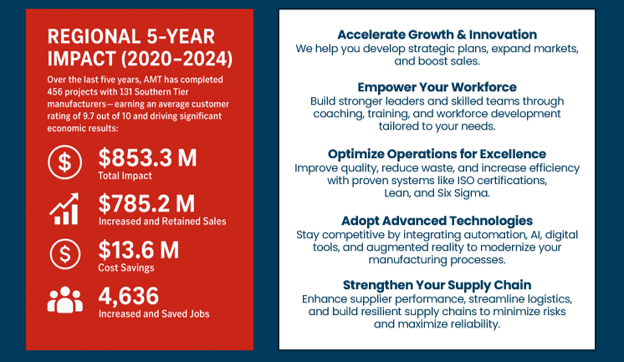
Our Score Card!